
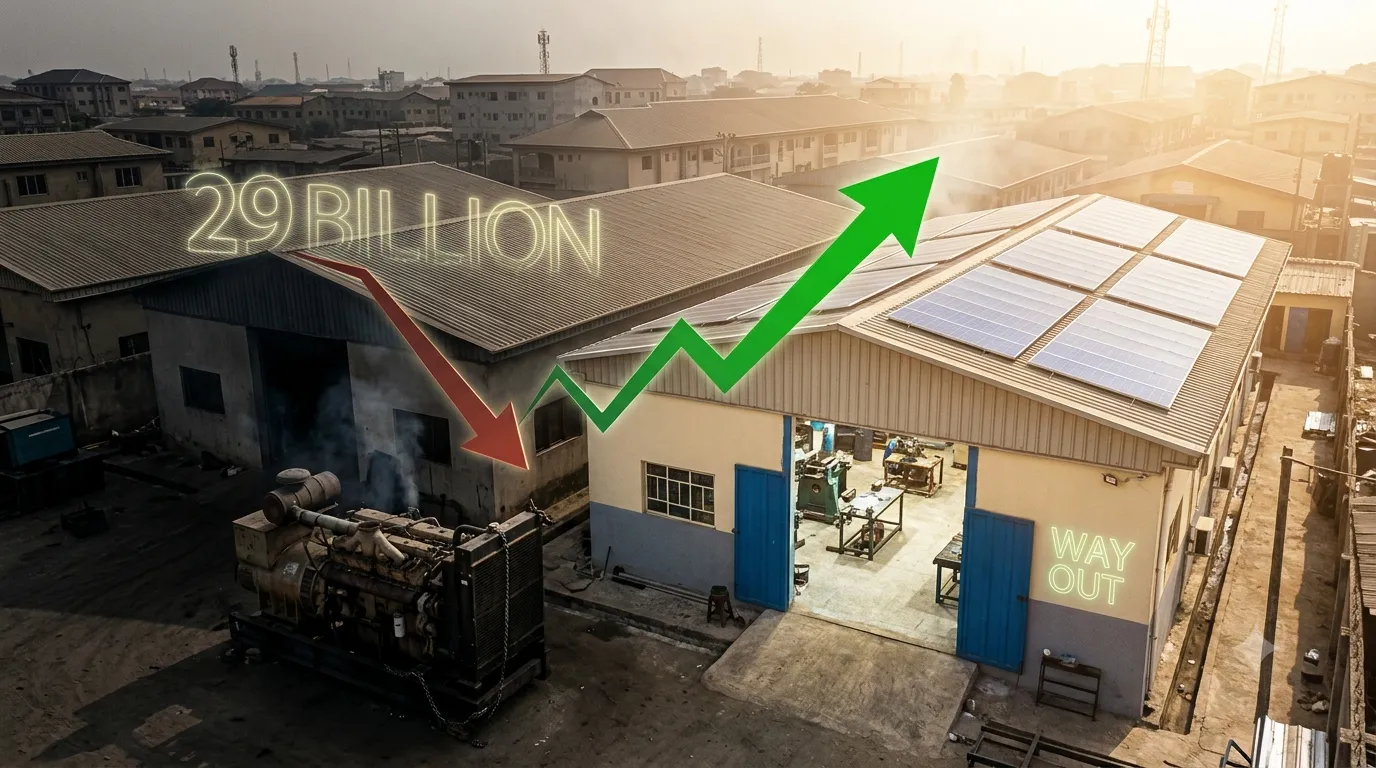
Every Nigerian business owner has a second job they never applied for: power plant operator. The Nigeria energy crisis costs businesses an estimated $29 billion annually according to the World Bank — roughly the GDP of a mid-sized African nation, burnt in diesel and downtime every single year.
What Is Driving the Nigeria Energy Crisis?
The arithmetic is brutal. Nigeria has over 200 million people and grid capacity that frequently delivers under 5,000MW — a fraction of comparable economies. Decades of underinvestment in generation, a transmission network that loses much of what is produced, and distribution companies caught between tariffs and theft complete the picture. The result: over 40% of Nigerians lack grid access entirely, and those connected plan their lives around its absence.
Who Actually Pays, and How Much
- Manufacturers: self-generation can consume a devastating share of operating costs, pricing Nigerian goods out of their own markets
- SMEs: the barber, the cold-store owner, the printer — each running a private power station on retail diesel
- Households: the “generator economy” is estimated in billions of dollars of annual fuel spend
Why Waiting for the Grid Is Not a Strategy
Grid reform is genuinely underway — but grid build-out is measured in decades, and your production schedule is measured in days. Businesses that thrive here treat reliable power as their own capital project, not a public promise.
The Exit Routes That Actually Work
Distributed energy is the pragmatic answer: solar PV for daytime load, battery storage for evenings, generators demoted to backup. Solar module prices have fallen roughly 90% since 2010 (IRENA), flipping the economics decisively. Payback periods that were fantasy a decade ago are now routine.
The Mindset Shift
Stop treating diesel as a cost of doing business and start treating it as a debt you can retire. Every month of ₦250,000 diesel spend is ₦3 million a year that could be converting into an asset on your roof.
The Nigeria energy crisis is real, but for individual businesses it is increasingly optional. Want to know your own exit number? Book a free energy audit — measurement first, promises second.